The CATS Advantage: The Cawood Ledford Post-Grad Program
“Rings on fingers, diplomas in hands,” is the mantra coined by University of Kentucky Athletic Director Mitch Barnhart. This saying is more than a statement as it serves as the mission and ultimate purpose of what it truly means to become a Wildcat student-athlete.
Winning in the classroom is just as important as winning and dominating on the field or court and the implementation of a resource center such as CATS (Center for Academic and Tutorial Services) helps complete that equation. For 50 years, CATS, the first facility of its kind to be exclusively dedicated for the academic development of student-athletes, has been paramount in aiding young men and women beyond their sport not strictly for a set of four years, but after they turn pro, so they can come back to finish what they’ve started to ensure their lives beyond their athletic careers.
Cawood Ledford, the “Voice of the Wildcats” for 39 years, was a staple of the University of Kentucky. The decorated 22-time Kentucky Sportscaster of the Year and 1994 National Basketball Hall of Fame inductee’s legacy lives on not only athletically, but academically as well. Many former UK athletes have come back to finish their college degree under his scholarship program that covers their tuition and books. This initiative, in conjunction with CATS, has helped 192 Wildcats return to UK to complete their degree. The program has served the likes of Oliver White, Derek Anderson, Anwar Stewart, Jodie Meeks, Randall Cobb, Vonda Jackson, Wilbur Hackett, and more recently, Rajon Rondo. These returning athletes are motivated for more reasons than just receiving a piece of paper that says they completed college. They are driven by fulfilling promises to their families and coaches, showcasing that they’re more than athletes, and wanting to be a role model for children and future student athletes.
Oliver White’s story serves as the exemplary demonstration of CATS grace for committing to the care of its athletes through the Cawood Ledford post-grad program. White was a standout tight end at the University of Kentucky from 1981-1984 and ended up being drafted by the Pittsburgh Steelers in the 10th round of the 1985 NFL Draft. He would only play one season in the NFL, and after that he relocated back to Kentucky and started working as a supervisor and plant manager. He was content with that because he was married and earning an honest living for his family, but when he witnessed his two sons receive their college degrees before him, he realized that it was finally time for his turn. After both of his sons graduated from college, Alec from the University of Louisville and Aaron from the Eastern Kentucky University, Oliver decided to return to Kentucky 30 years later to work on achieving his degree.
Once he officially returned to campus, his first step was to reach out to Bob Bradley, the founder of CATS, about starting the process. Bradley discovered that when pulling out White’s file, the degree he was on track to earn as an undergraduate was no longer offered. White had to undergo a whole reconstruction of his major and thanks to the advice of Bradley, he decided to pursue a community leadership and development degree to help prepare him for entering the profession of working with a non-profit organization or at UK. In May of 2018, Oliver White would deliver on his commitment by ultimately walking across the stage and receiving his diploma.
“When you’re young, you don’t think ahead, I tell these guys, finish your degree while you’re there because sooner or later, you’re not going to be able to play ball,” White said.
UK Athletics and the Student-Athlete Experience division, in tandem with the Cawood Ledford Program, are dedicated to developing its’ student-athletes into leaders of character, competence, and consequence for play and for life.
Vonda Jackson, now known as Vonda Young, was a member of the women’s basketball team from 1994-98 and her story is another demonstration of the importance of CATS and Cawood Ledford Program. Even though Vonda competed for the Wildcats for four years, she didn’t complete the degree process during that time. That would all change when she was eating lunch one day with another former member of the women’s basketball program, Mia Daniel. Daniel had graduated the year before Jackson had become a Wildcat and was trying to persuade Vonda to go back and finish since she was only a semester away. Mia’s persuasion wouldn’t pay off until a women’s basketball coaching member by the name of Jerry McLaughlin stepped in and got onto her about not finishing yet.
“Once Coach McLaughlin heard I only had a semester to go to complete my degree, he said that if I didn’t go back and do it, he wouldn’t stop calling me until i did so,” Young said.
This really put it into perspective for Vonda, because she already felt like something was missing from her college experience and noted that not officially receiving her degree left a sense of incompleteness in her life.
“When you don’t complete it, it feels like something is missing. I would talk to not only former fellow athletes but others who finished their undergrad and it always sat in the back of my mind to go get it done,” Young said.
In 2023 after her daughter graduated high school, she felt like she finally had the proper amount of time to dedicate to her own schooling. Vonda initiated that process by contacting CATS advisor Michael Stone to help her get started. It wouldn’t be too much of a challenge for her to finish because she needed only one semester. She initially wanted to go into nursing and work with infants, but quickly realized that high school chemistry and anatomy classes were incredibly less challenging than Kentucky’s chemistry and anatomy courses. After talking with her advisor, Mike Haley, she decided to pivot into achieving a degree dealing with family and individual development, so that she could work with children in the school system as a counselor. She felt comfortable with this change thanks to her advisor because she always knew she could go to Mike with any problem or situation, and he would conjure up great advice.
“I loved that man, great human being, you can confide in Mike, and he would really listen and guide you because he cared about your well-being,” Young said.
She was on track to receive that degree while she was playing, but just like Oliver White when she returned in 2024, the degree was no longer available. But it wasn’t completely a wash since she learned that she was only two history classes from earning a minor in history along with being a couple of classes away from gaining a degree in liberal studies. After discovering this, that is exactly what Vonda would do, as she ended up graduating from the University of Kentucky with a bachelor’s degree in liberal studies which allowed her to follow her passion of working with children within the school system as a counselor. She ultimately credits the advisors of CATS for urging her and guiding her back to finish what she had started years ago.
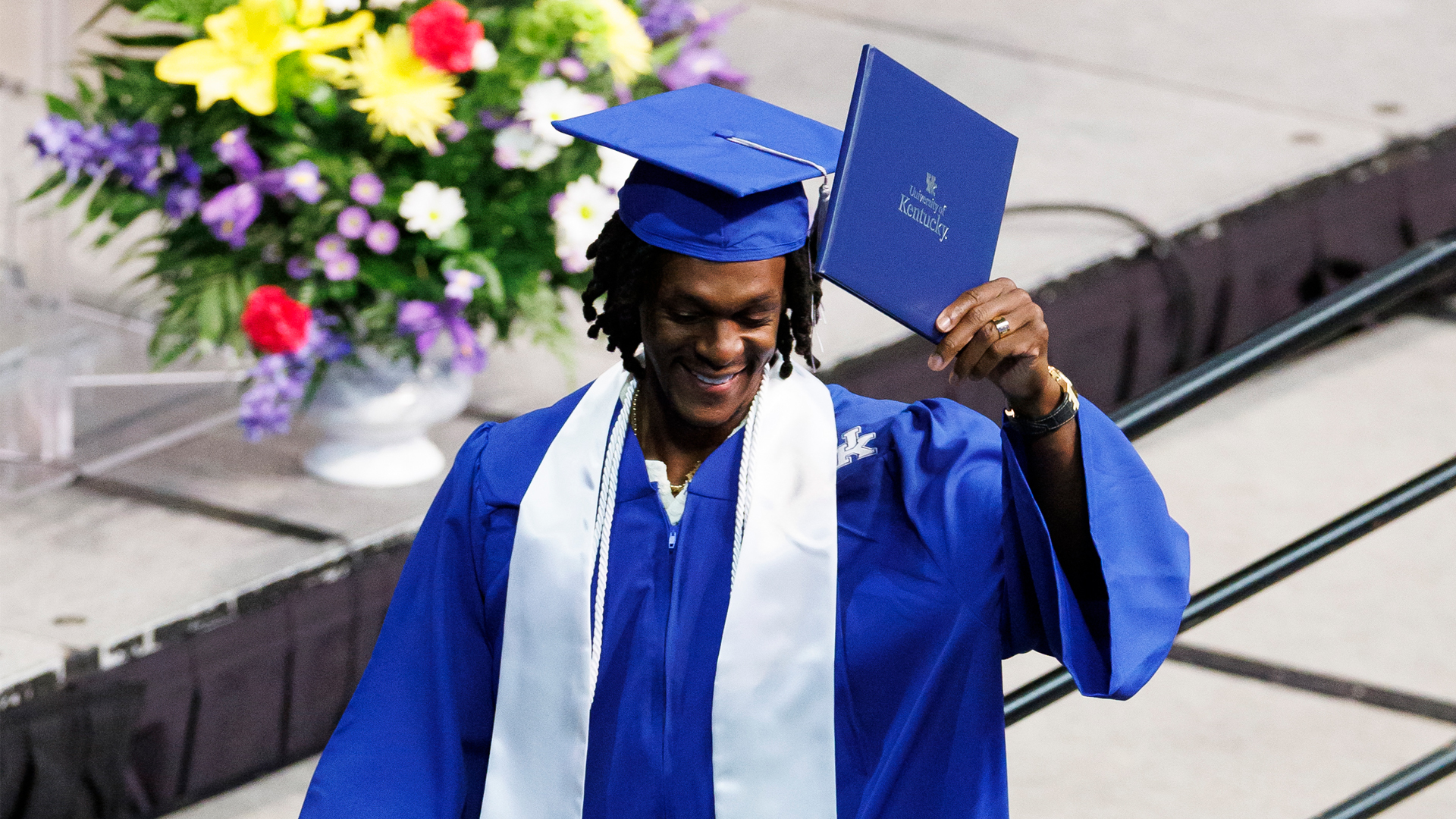
On the day 20 years after Rajon Rondo had last suited up for the Wildcats, he found himself dressed in a blue gown walking across the Rupp Arena stage to receive his bachelor’s degree in communication. Rondo credits many different aspects of his life after basketball for fueling his desire to come back and use the Cawood Ledford Program.
Rondo is a two-time NBA champion who enjoyed a 16-year playing career and suggested that with the increased availability in his schedule from being a stay-at-home dad in the summers, along with the urgency and persistence of his former college counselor, Michael Stone, it was time to get his college degree. Rondo also acknowledged that the timing made sense because he was already 60% finished with his degree, and he wanted to finish it before his daughter graduated high school.
For many Cawood Ledford athletes going back to school can be quite the adjustment after spending years away from the classroom, but Rondo said that difficulty was overcome by the pure joy he had for being on campus again.
“The energy the younger kids had gave me life and made me feel more passionate about being on Kentucky’s campus once again,” Rondo said.
Now with his bachelor’s degree, Rajon can ultimately pursue coaching basketball at the collegiate level.
Recruiting is another essential advantage that the Cawood Ledford post-grad program and CATS resources play in separating the University of Kentucky from other universities. Makini Campbell, the mother of former Kentucky big-man Dakari Johnson, said the post-grad program in affiliation with the assistance of CATS played a pivotal role in her son’s decision to come to Kentucky in 2013.
As an elementary teacher and school counselor for 10 years, she wanted to send Dakari somewhere where they won’t just invest in his athletic ability, but they needed an institution that would cultivate his academic growth towards completing his degree, whether he turned pro early or not.
UK brought freshmen to the campus early in the summer to get a jumpstart on their credits and adjust to campus life, which made her feel comfortable with her son to make the transition from high school to college.
The crucial resource that CATS had proven to be for Dakari in his two seasons at Kentucky had completely blown her mind because it provided him with a student guide on how to balance two full-time jobs of academics and athletics at the D-1 level.
“Dakari in his first year made the national championship game and in his second year made the national semifinal, so Michael Stone along with academic service assistants would help him stay on top of his schoolwork by making sure he met his deadlines while consistently traveling. Stone never let Dakari slack off at any point in his time at Kentucky and he wasn’t afraid to pick up the phone and call me to talk some sense into him if he was slipping up.”
Along with the help in balancing academics, Makini was appreciative of how comfortable, relaxing, and inclusive the environment CATS was, for not just Dakari and his basketball teammates, but the other sports as well. It gave athletes a sense of belonging at the University outside of their sport by connecting with different counselors, tutors, and learning specialists.
CATS creates an environment where all student-athletes can maximize their academic, personal, and social growth and improve their post-college quality of life because It’s not just about keeping young student-athletes eligible for competition in their respective sports. The Cawood Ledford program wouldn’t be as successful if it were not for the counselors and administrators of CATS who constantly poured into the well-being of the student athletes whether they were still in school or out of it. As this was written, 192 former athletes have already returned to graduate using this avenue and, in the fall of 2026, the number is expected to reach 200.
Oliver White and Vonda Jackson’s stories articulate how the post-playing career hinges upon getting that degree from the University of Kentucky, so more doors of opportunity can open for them once the athletic career is over.